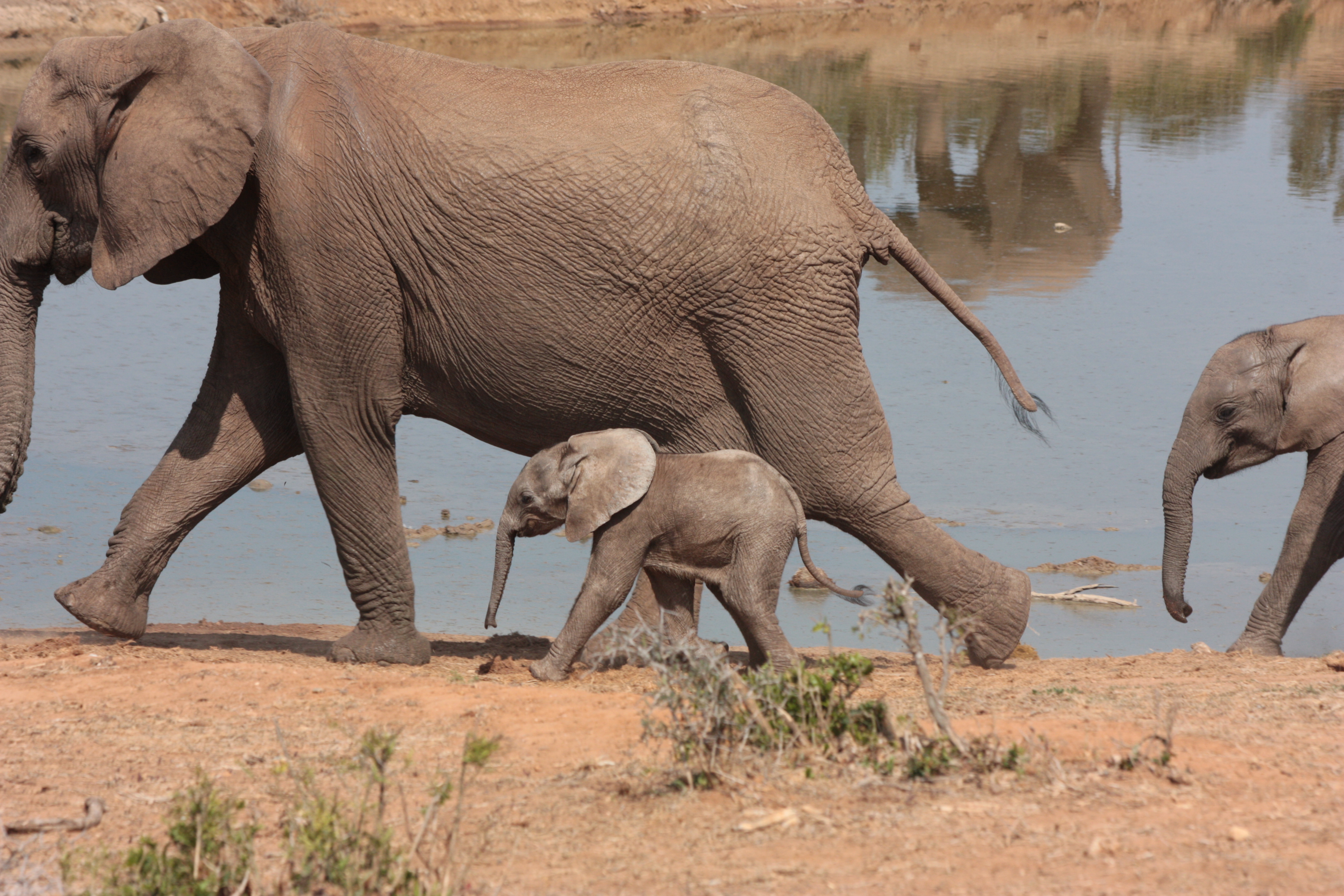

It’s Mother’s Day in the US this weekend! So, for this week, we’ll examine one of the animal world’s best mothers: the African elephant.
There are two species of African elephants: the African savanna elephant (Loxodonta africana) and the African forest elephant (L. cyclotis). Both species live in Africa but in different parts of the continent. African forest elephants live in the forests of West and Central Africa. In contrast, African savanna elephants live in the savannas and grasslands of sub-Saharan Africa. African savanna elephants are larger between the two species and have tusks that curve outwards.
African elephants get an award for mothering because it takes up a lot of their time. African elephants have the longest gestation time of any living animal and are pregnant for an average of 22 months! They also give birth to the largest babies among terrestrial animals. Calves are 265 pounds (120 kilograms) when born. This big size at birth makes sense when you remember that African elephants are the biggest land animals – an adult African savanna elephant is 10-13 feet tall (3-4 meters) and weighs 4-7 tons (4,000-7,000 kilograms)!
Oh, and for those curious, there is one more elephant species, the Asian elephant (Elephas maximus). Asian elephants live in (you guessed it) Asia. Behaviorally, Asian and African elephants are very similar but have some physical differences! For example, Asian elephants have smaller ears than African elephants. African elephants also have looser, more wrinkly skin and a concave back instead of a rounded one.

Herd life
African elephants live in herds guided by a matriarch, usually the biggest and oldest female in the group. The matriarch leads the herd to food and water, avoids predators, and finds shelter. In other words, the matriarch holds the knowledge vital to the herd’s survival. She also plays an essential role in teaching young elephants how to behave.
Her herd is comprised of other females and their young, all of whom are usually related to the matriarch. Females will help care for each other’s young, protecting them from predators. Female elephant calves typically stay in with their birth herd in adulthood. Once a young male elephant reaches adulthood, he leaves the herd to roam either alone or in a loose male-only herd. Males typically only come into contact with females when it’s time to breed.

Trunks!
An elephant’s trunk is a fusion of its upper lip and an elongated nose. But African elephant trunks are more than just a nose; they’re basically a fifth appendage. Trunks are highly dexterous and can have up to 40,000 muscles and 150,000 muscle fascicles (bundles of muscle fibers)! Trunks are strong and agile: an elephant can knock over a tree with its trunk and use it to pick up a single piece of straw.
Trunks serve many different purposes. For instance, an African elephant can suck up water to drink with its trunk; a trunk can hold up to 8 liters of water at a time. But remember, a trunk is an elephant’s nose and is connected to their lungs. To drink, elephants only pull water up partway through their trunk. Then, they put their trunk in their mouth and let the water pour in.
In addition to drinking, an elephant can use its trunk for gathering food. An African elephant has two small fingerlike features at the end of its trunk that it can use to pick up small items like leaves between thorns. More commonly, however, an African elephant is just trying to shove as much food in its mouth as possible. They eat between 165 and 330 pounds (75 to 150 kilograms) daily!]


Tusks!
African elephants have another characteristic feature: tusks! Both male and female African elephants have tusks that grow throughout an elephant’s life, starting when the elephant is two or three years old. Tusks are long teeth that have grown outside an elephant’s mouth. Each one is made mainly of dentine, the hard, bony tissue that makes up most of the supporting structure in our teeth. And just like our teeth, elephant tusks are covered in enamel.
Just like we have dominant hands, elephants have dominant tusks. An elephant’s dominant tusk is usually smaller due to frequent use. Tusks protect an elephant’s trunk, move objects, and even remove bark from trees. An African elephant may also use its tusks for defense. An elephant can use its tusks to dig holes to reach underground water if times are tough.
Can an elephant regrow a broken or missing tusk? Unfortunately, no. Just like we can’t regrow adult teeth, a broken tusk is broken forever. This can be very painful for elephants, since their tusks are connected to their skulls and full of nerve endings.


Elephant talk
African elephants have various vocalizations that they use to communicate with each other. Like us, African elephants can communicate with each other through body language. They also use scent and touch to send signals to other elephants.
Elephants also have many different auditory signals. For example, elephants can use their trunks to make trumpeting calls. Some of these sounds are actually too low for us to hear! These extremely low sounds can create vibrations traveling miles through the ground. African elephants may sense these seismic vibrations through their extremely sensitive feet and/or through bone conduction.
One last fun fact: an elephant’s skull weighs about 115 pounds (52 kilograms). Their skull would be even heavier, but luckily, elephants have honeycomb-like spaces that reduce weight without sacrificing skull structure.
Resources
Leave a Reply