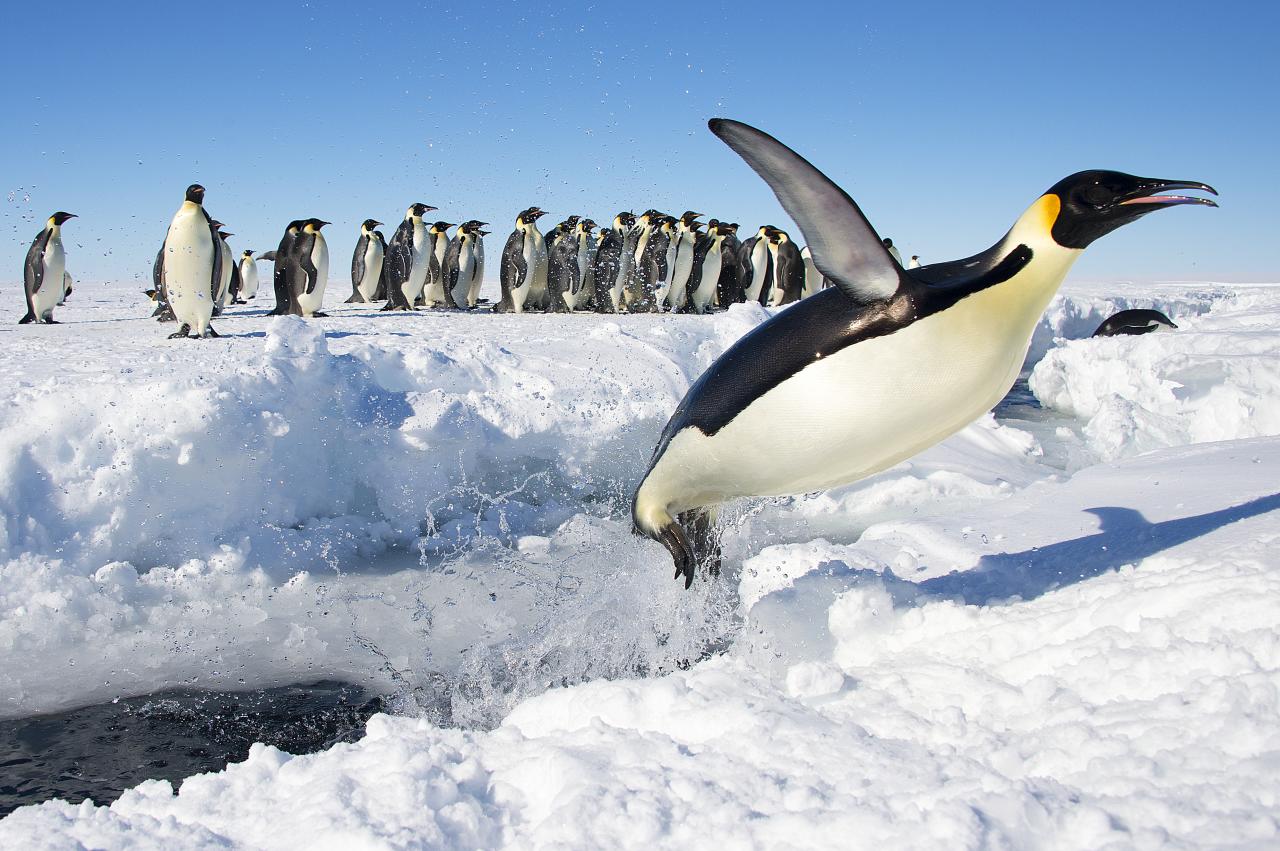

It’s Father’s Day in the US this Sunday! I’ve talked about some excellent animal fathers in the past (e.g., seahorses and jacanas), but one has been on my mind for a while.
It’s finally time to talk about the coldest father: emperor penguins.
Emperor penguins (Aptenodytes forsteri) are the largest penguin species and the largest seabirds in Antarctica overall. They are, on average, 48 inches tall (1.2 meters) and weigh up to 88 pounds (40 kilograms). Picture the average 6-year-old human, and you have a good sense of the size of an emperor penguin! Emperor penguins spend their entire lives in Antarctica and on ice floes off the coast.
Winter eggs
Emperor penguins breed in sync with the build-up of sea ice, arriving at their breeding grounds in early-mid April and the start of Antarctica’s winter season. Once there, males and females use vocal calls to find mates. Once a pair has formed, they stop vocalizing; this helps keep the noise down for other individuals trying to find their breeding partner. While emperor penguins are monogamous within each breeding season, they almost always find a new partner yearly.
Females quickly get to work and lay their single egg by late April to early May. They then immediately transfer the egg to the father for safekeeping. This is the tricky part – the female has to position her egg on top of the male’s feet. If the pair drops the egg, it almost always dies. The egg cracks (not good) or freezes to death on the cold ground. This egg transfer maneuver is so tricky that first-time parents often mess up. The pair bond breaks when this happens, and both parents return to the ocean to try again next year.

After a successful egg transfer, the female immediately leaves her mate and newly laid egg to return to the ocean to find food. This is when the father’s long watch begins. He will stay in the breeding colony with the egg on his feet throughout the darkest, coldest parts of winter until his egg hatches in mid-July. He keeps the egg warm in his brood pouch, a specialized skin fold on his lower abdomen. Fathers fast during this incubation period and go months without eating. By the time the egg hatches and the mother returns, the father will have lost about 40% of their body weight.
Emperor penguin fathers put up with a lot to keep their eggs warm. Remember, they are incubating their eggs during the Antarctic winter, where wind chills can be as low as -76 degrees Fahrenheit (-60 Celsius). These winds can be as fast as 125 miles per hour (200 km/hr). How do emperor penguins stay warm when it’s so cold? Partly due to their body adaptations. Emperor penguins have two layers of feathers and proportionally smaller beaks and flippers than other penguins, which help reduce heat loss. The soles of their feet (plantar surface) don’t touch the ground, which minimizes heat loss, and special fats in their feet stop them from freezing.
Emperor penguins also stay warm by standing in huddles. This huddling behavior is unique, and emperor penguins are the only penguin species that aren’t territorial. A penguin huddle can range from less than 200 birds to over 5,000, and individuals take turns staying in the center of the huddle. Huddling can cut the heat lost by 50% and helps the fathers keep their fat stores longer. The warmer they are, the less fat they need to burn and the longer their fat lasts. The middle of an emperor penguin huddle can reach 75 degrees Fahrenheit (24 Celsius)!
Growing up on the ice
Hopefully, the mother will return by the time her egg hatches. Whether or not she makes it in time depends on how far she has to travel to and from the ocean. If she hasn’t arrived, the father can feed his new chick for a few days with crop milk, a milky substance made from his esophagus. Male emperor penguins are one of the only birds that can produce crop milk, along with pigeons, doves, and flamingos.
But eventually, the mother returns to her mate and chick. After locating her partner by vocal cues, she takes over chick care, and the father can return to the ocean to eat. Female emperor penguins feed their chicks regurgitated food and keep them warm in their brood pouches.


When they are about a month old, emperor penguin chicks start spending more and more time outside of brood pouches and on their own. They continue to rely on their parents until they are about 5 months old. During this time, their parents take turns foraging in the ocean and bringing back food for the chicks. Eventually, though, the chicks are large enough that both parents need to gather food. The juvenile chicks are left behind and form huddles to keep warm. By December, the chicks are almost as large as their parents, and their adult feathers are beginning to come in.
Penguin adulthood
Once they reach adulthood, emperor penguins are among the top predators in the Antarctic Ocean. Their most common food sources are fish and krill, and their spiky tongues help them catch slippery fish easily. Emperor penguins can dive deeper than any other bird (1,850 feet) and stay underwater for more than 20 minutes when hunting.
But emperor penguins aren’t alone on the top of the Antarctic food chain – orcas and leopard seals will eat them given the chance. However, emperor penguins are large enough that these predators may avoid them if there is smaller, easier prey around. Emperor penguins also avoid predation by keeping their dives shallow and short. This gets them out of the water before an orca can catch them.
The emperor penguins that survive to adulthood spend their summers fattening themselves up for the long, cold winter. After all, those dedicated emperor penguin fathers must prepare to fast for four long months!

Resources
Leave a Reply