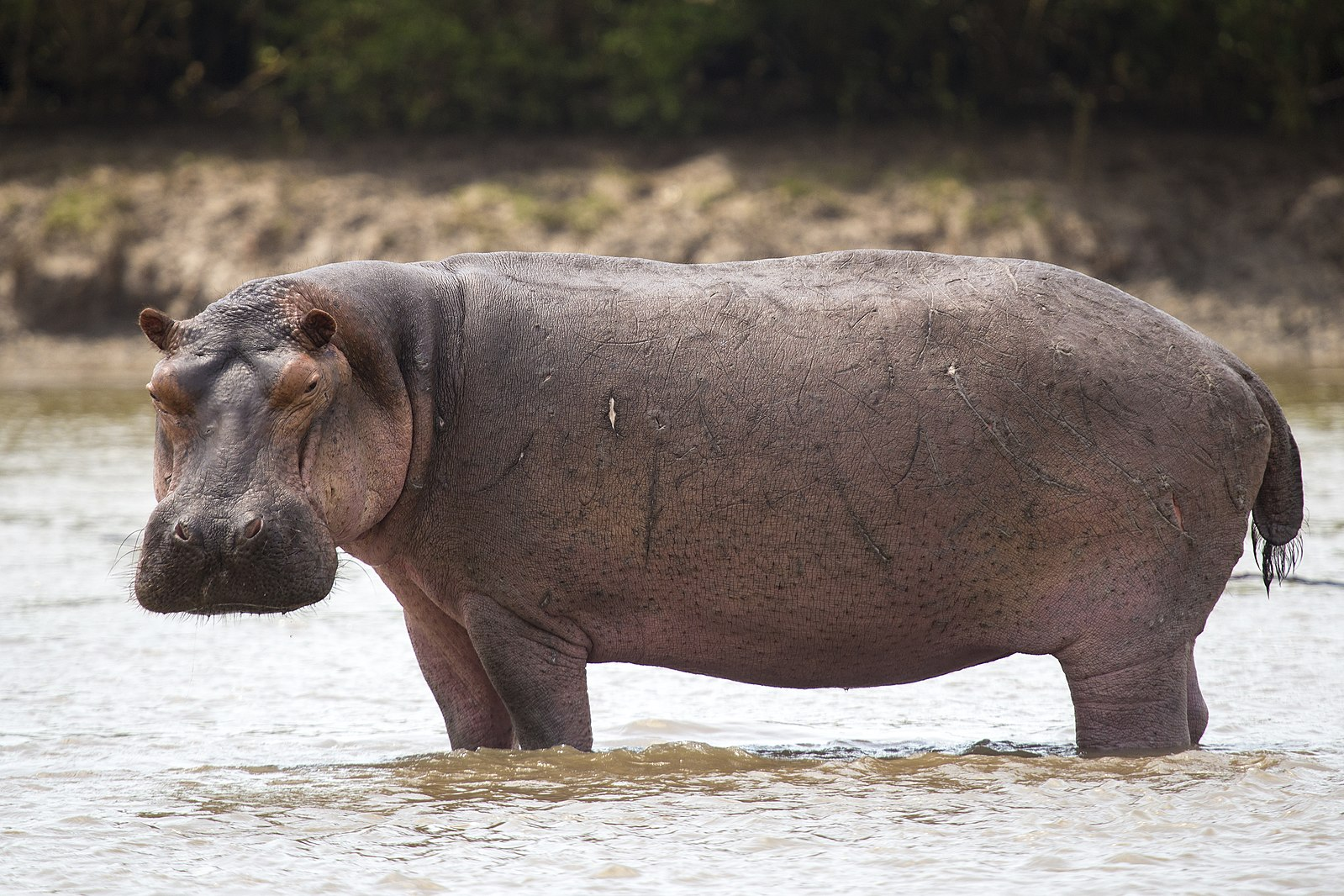

The fun part about science is that there’s always something new to learn. And there’s nothing more fun than new animal facts! Today, I want to share the latest on one of the world’s largest land mammals: the hippopotamus.
Also known as the large hippopotamus or river hippopotamus, common hippopotamuses (Hippopotamus amphibius) are the larger of two hippopotamus species. They are the third-largest living land mammal (elephants and white rhinos take the first and second spots). The average hippo weighs between 1.4 and 5 tons, stands about 5 feet tall (1.5 meters), and is 6 to 16.5 feet long (2 to 5 meters). Common hippos live in East Africa, south of the Sahara Desert. Their preferred habitat is shallow lakes, rivers, and swamps with water deep enough for them to stay submerged.
Here’s the fun science news: hippos can fly.
A recent paper found that hippos move on land with a two-beat gait called a trot. In trots, an animal’s diagonal legs move forward simultaneously. What’s interesting about hippos is that they only use trots, no matter how fast they go. (Other animals, like horses and rhinos, transition from a trot to a canter or gallop as they gain speed).
When reaching their top speeds of 14 to 15 miles per hour (22 to 25 kilometers per hour), hippos become briefly airborne between strides. They are airborne for about 0.3 seconds per stride or about 15% of their total running time. In one sense, this means that hippos are more athletic than elephants, who never become airborne.
Semi-aquatic
Hippos don’t only fly through the air; they can move extremely quickly through the water, too. These semi-aquatic animals have webbed toes and short, powerful legs to propel them through the water. Other aquatic adaptations include:
- Eyes, ears, and nostrils on the top of their head so their body can stay submerged.
- Transparent membranes on their eyes that act as goggles when they’re underwater.
- Nostrils that close underwater.
- The ability to hold their breath for 5 minutes or more.
- A bobbing reflex that pushes them up to the water’s surface every so often for a breath before sinking back down, allowing them to sleep underwater.
But even though hippos seem perfect for water living, they have one weakness: they can’t swim! Their bodies are too dense to float, so traditional swimming is out of the question. Instead, hippos sink to the bottom of the river and move by walking along or pushing off the riverbed.


Hippos leave their aquatic homes at night to go grazing for five to six hours. They’ll eat about 88 pounds (40 kilograms) of grass and plants during this time. This is a modest amount of food for such a large animal – only 1 to 1.5 percent of their weight. Humans, on average, eat 2 to 3 percent of their body weight daily. Since they spend most of their lives chilling in the water and not expending much energy, they don’t need to eat much. Hippos can also store two days’ worth of food in their stomach and go three weeks without eating.
Bloat of hippos
Hippos usually live in groups of 10 to 30 individuals, each guarded by a dominant male. These groups (called herds, bloats, or pods) can grow up to 200 individuals when water is scarce. Each herd comprises a dominant male, several subordinate males, and several adult females. The dominant male is usually the only one to mate with his females, but he sometimes allows other males to mate.
Hippos maintain territories through the help of their flat, paddle-like tail. When the dominant male poops, he flings his dung around with his tail to spread it as far as possible.
Mouth full of teeth
Hippos take territorial disputes very seriously and are one of the most dangerous and aggressive mammals. They protect themselves with a set of continuously growing canine and incisor teeth. These canines can reach 20 inches (51 centimeters) long.
Rival males size each other up through gaping, where they open their mouths as wide as possible. It’s impressive since hippos can open their mouths to a 150-degree angle. This gaping is usually enough to get the smaller male to leave, but the two battle by slashing their tusks or swinging their heads if he doesn’t get the hint.


While hippos usually only fight with other hippos, humans must also be cautious. Hippos can easily kill someone if provoked or threatened; it doesn’t take much to set off a hippo. And with their strong jaws, hippos can cut humans in half with a single bite. You are more likely to die in a hippo encounter than in a lion or shark encounter.
Blood and sweat
There’s a myth that hippos sweat blood, but this isn’t true! For one thing, hippos don’t have sebaceous glands to even produce sweat in the first place. They instead rely on mud or water to remain cool during the day. Remaining in the sun for too long can lead to dehydration.
But while they might not be sweating, hippos do release a viscous fluid from their pores called “blood sweat.” This thick, red substance contains a mix of hipposudoric acid and norhipposudoric acid. Together, they create a layer on a hippo’s skin that protects it from sunburn by absorbing ultraviolet rays from the sun and dehydration. These substances could also help prevent infections by preventing bacterial growth, which helps explain why hippos don’t usually get infections after fights.
So, to sum up what we’ve learned today:
- Hippos don’t sweat blood
- They’re aggressive, and you should give them plenty of space
- HIPPOS CAN FLY!!!!! (kinda)
Resources
Leave a Reply