

Yesterday was Halloween! A very spooky time, filled with ghosts, vampires, and, of course, bats!
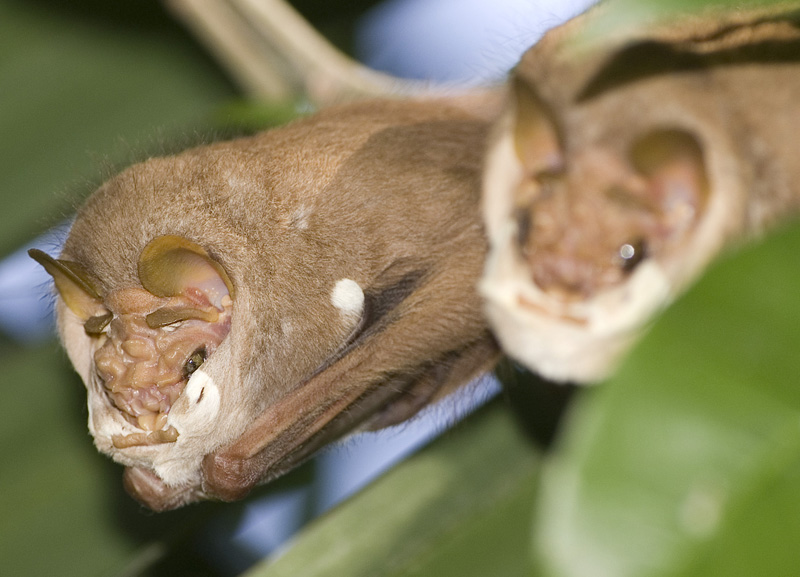
There are many great bats in the world, including vampire bats and hammer-headed bats. Here’s another great (and interesting looking) bat: the wrinkle-faced bat.
Wrinkle-faced bats (Centurio senex) are medium-sized bats, on average 2.17 inches (55 millimeters) long and weighing about 17 grams. They live in Central and northern South America, preferring to make their homes in dense forests.
It’s easy to see where wrinkle-faced bats get their name: their faces are covered in wrinkles and folds of skin. Their scientific name alludes to their wrinkles, translating roughly to “100-year-old man.” Males also have white, velvety skin folds around their necks.
Wrinkle-faced bats also have unique wings! First, one of their wing panels is translucent. While wing translucency isn’t rare, almost all bats it occurs in have it throughout their wings, not just in one panel. Second, the rest of their wing is covered in wing stripes, something no other bat is known to have.
Leaf-nosed bat
Although they eat fruit, wrinkle-nosed bats are not fruit bats. “Fruit bat” is a term for members of the bat family Pteropodidae. Also known as megabats, fruit bats tend to be large, and most don’t echolocate.
Wrinkle-faced bats are instead classified as New World leaf-nosed bats (family Phyllostomidae). There’s a lot of variety within leaf-nosed bats, but many have large, lance-shaped noses. These noses are thought to help the bats find food through echolocation.
Even though wrinkle-faced bats don’t have the characteristic “leaf-nose,” they’re placed in their own genus within the leaf-nosed bat family. And they’re unique: wrinkle-faced bats have the strongest bite force relative to their size among all the leaf-nosed bats. These strong jaws help them bite through unripe fruit, unlocking a food source when times are tough.
Unique face
We can clearly see that wrinkle-faced bats have wrinkly faces. But what purpose do they serve?

While they can eat hard, unripe fruit, wrinkle-faced bats prefer squishy, overripe fruit. The folds on their face could help filter fruit juice while feeding on this squishy fruit or direct it into their mouths.
More importantly, the wrinkles could serve an important function in echolocation. Leaf-nosed bats echolocate from their noses; the folds in grooves in a typical leaf-nosed bat help modulate and focus various echolocation frequencies. This, in turn, helps the bat find food better. While wrinkle-nosed bats don’t have the classic leaf nose, they have plenty of wrinkles and folds in their face. There’s a good possibility that their face itself helps module their echolocation.
Masks and Mating
Remember how I mentioned earlier that male wrinkle-faced bats have extra skin folds around their necks? These fuzzy skin folds play an essential part in mating!
In 2018, a team in Costa Rica stumbled upon a group of male wrinkle-faced bats hanging out together. These males would pull their fuzzy skin folds up around the lower half of their face, much like a face mask that we would wear. Mask in place, the males would spend the night emitting ultrasonic calls and song sequences.
This suggests that wrinkle-faced bats are a lekking species: males gather in an area and perform to attract a female mate. The best, most attractive male gets the most mating opportunities. And indeed, the team saw at least one pair of bats fly off to mate.
Wrinkle-faced bats: the original masked singer!


Resources
Bat Conservation International
Leave a Reply