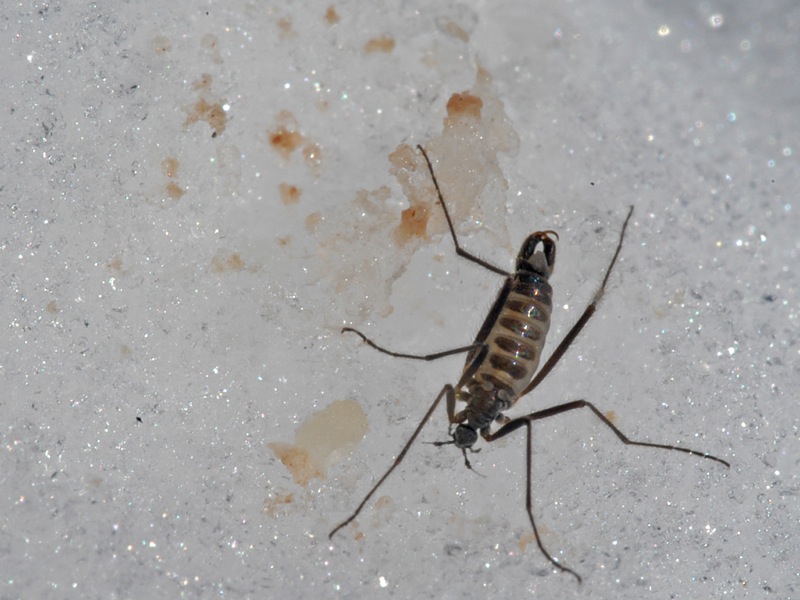

When you’re in the middle of winter, it seems like everything is hibernating, waiting for warmer days.
But some things are still active! I recently learned about a surprisingly active animal during the cold: snow flies.
Snow flies (genus Chionea) are a specialized type of crane fly. What’s a crane fly? You’ve probably seen one flying around, even if you didn’t know what it was. Also called “mosquito hawks” or “skeeter-eaters,” crane flies are large, semi-mosquito-shaped insects with really long legs. While they look gross and can be a nuisance, crane flies can’t bite and are harmless to humans.

But back to snow flies! There are around 37 species of snow flies, all of which live in the Northern Hemisphere. You can find them in North America, Europe, and Asia, with many species preferring to live at high altitudes. Snow flies live considerably longer than other crane flies: adults, in some instances, live up to two months, while the typical crane fly’s lifespan is usually 10 to 15 days. Snow flies also differ from crane flies because they lack wings!
One speculation for the lack of wings is that flying requires a certain amount of energy; in the dead of winter, snow flies don’t have any energy to spare. The lack of wings could also be an adaptation to cold temperatures and wind. Female snow flies have repurposed the area typically filled with flying muscles as a storage station for their eggs.
Life under the snow…
This lack of wings isn’t usually a problem for snow flies since they spend most of their lives underground or under the snow. The larvae, for instance, grow underground, feeding on decaying plant matter or rodent poop. Unlike most insects, snow fly larvae hatch in the summer and pupate in the fall. By the time they’re adults, winter has come, and snow has started to fall.
As adults, snow flies live in what is known as the subnivean environment: the space between the snowpack and the ground. They find hollow pockets to hunker down in, like rodent burrows or cavities made by vegetation. The subnivean zone is a relatively cozy place to live, with temperatures remaining stable at freezing or just below freezing. A snow fly’s needs are mostly taken care of in this environment: it’s relatively warm, and they don’t need to look for food (snow flies don’t even appear to need to eat!).
…and life on top of it
But snow flies can’t always remain under the snow: they need to leave the relative warmth to search for mates. When the temperature reaches around 28 degrees Fahrenheit (-2 degrees Celsius), snow flies leave their subnivean homes and search for unrelated individuals to mate with.
Like a natural anti-freeze, many insects survive the cold by producing sugars and proteins that stop ice crystals from forming in their bodies. The most cold-tolerant insects can survive temperatures well below -13 degrees Fahrenheit (-25 degrees Celsius). Surprisingly, snow flies aren’t particularly freeze-tolerant! They aren’t great at making anti-freeze, and they die when their body temperature drops to 21 degrees Fahrenheit (-6 degrees Celsius). This is why snow flies stay in the relatively warm subnivean zone for most of the winter and only leave when the outside temperature reaches 28 degrees Fahrenheit.
But even though snow flies aren’t particularly freeze-tolerant, they have some unique adaptations to help them move around on top of the snow. Perhaps most importantly, their nerves and muscles are modified to operate up to the point of freezing. No slowing down as their bodies get colder! Their dark bodies also help by absorbing warmth from the sun on sunny days and increasing the temperatures they can walk around in.
Snow flies also have an impressive adaptation to avoid freezing: they self-amputate. When temperature-regulated nerves detect a freezing leg, the snow fly removes the leg in question. This stops ice crystals in the leg from getting into the body and destroying internal organs. Self-amputation gives snow flies a little time to escape the cold before freezing to death.
It’s a harsh life, but snow flies are well-adapted to it. There’s just one last question to answer: why did they evolve this way in the first place? One hypothesis is that the benefits of being active at a time when most predators aren’t (i.e., the dead of winter) outweigh the costs of a winter lifestyle. Another hypothesis is that the snow provides an easier thing to walk on for a wingless insect than the typical forest floor.
In other words, snow flies traded running from predators for running for warmth!

Resources
Leave a Reply