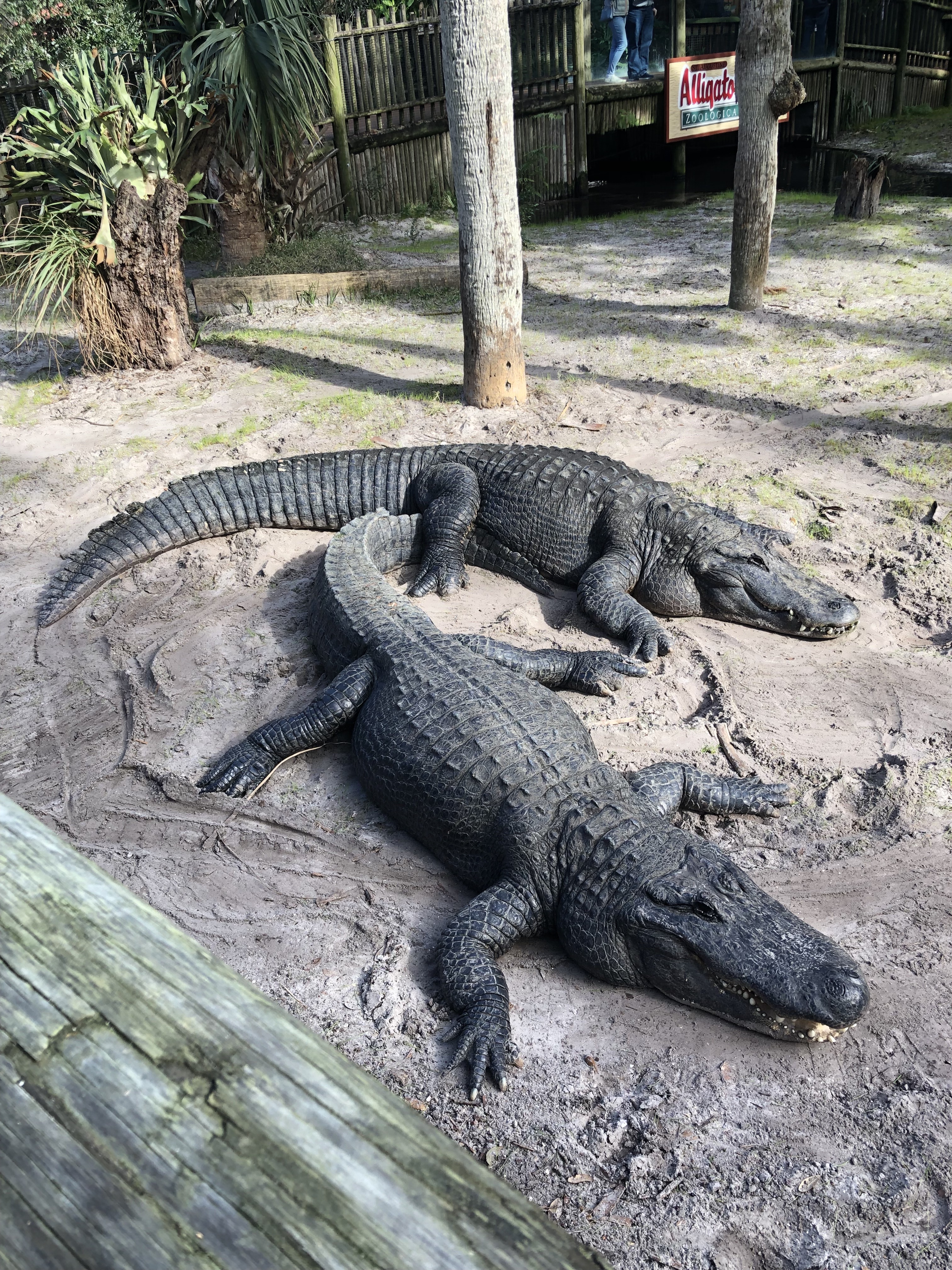

Happy New Year! I hope everyone had a wonderful holiday season. I spent mine in sunny Florida, home of the largest reptile in North America: the American alligator (Alligator mississippiensis). Outside of Florida, you can find American alligators as far north as North Carolina and as far west as central Texas.
But boy, do American alligators get big, especially the males. Both male and female alligators grow at roughly the same rate as hatchlings. But once they reach about three feet long, male alligator growth skyrockets. While an adult female alligator comes in at a still-impressive 8.5 to 10 feet (2.6 to 3 meters) long, adult males average 11 to 15 feet (3.4 to 4.5 meters)! This large size comes with an equally significant weight: a male alligator can weigh 1000 pounds (454 kilograms).
Alligator vs. Crocodile
First things first: what’s the difference between alligators and crocodiles?
Alligators, crocodiles, caimans, and gharials are all ‘crocodilians,’ reptiles belonging to the order Crocodylia. There are just two species of alligators: the American alligator and the Chinese alligator. Caimans are generally smaller than alligators and crocodiles and live in South America. Gharials are their own separate family of crocodilians and have a long, thin snout.


One good clue as to whether you’re looking at an alligator or a crocodile is to think about your environment. Alligators are most commonly found in freshwater, while crocodiles live in saltwater environments. Because of this, the only place you’ll see alligators and crocodiles together is in the southern tip of Florida.
Not sure what type of water you’re in? Don’t worry; you can tell the difference between alligators and crocodiles by their skulls. Alligators have a rounded nose like a “U,” while crocodiles have a pointed, “V”-shaped nose. In addition, alligators have an overbite. When their mouths are closed, all you can see are the top teeth. In contrast, a crocodile’s teeth can be seen when its jaw is shut. This is when you can see the prominent 4th tooth in a crocodile’s lower jaw.

Aquatic lifestyle
American alligators are primarily aquatic creatures, although you will see them basking in the sun on land. They are powerful swimmers and can move faster in the water than on solid ground. After all, American alligators have stubby legs, and moving that large body around takes a lot of energy!

However, not all aquatic habitats are equal in an American alligator’s eye. First, American alligators don’t have a salt gland and have a low salt tolerance as a result. You can find them in brackish water, but American alligators are most commonly found in freshwater habitats like marshes, swamps, rivers, and ponds. The exact habitat an American alligator picks depends on both their sex and size. Female alligators prefer to live in marshes and swamps where there are plenty of places to make nests, while the males are more likely to be found in open water. Small alligators also prefer wetlands because they can use the surrounding plants to hide from predators. As an alligator grows, it is more likely to be found in open waters.
American alligators will also change their habitat through the creation of gator holes. Gator holes are precisely what they sound like: holes an alligator makes in the mud using its snout and tail. An alligator can use its gator hole to remain comfortable throughout the year, regardless of temperature or weather. During the dry season, gator holes will remain filled with water, providing a drinking source for other animal species.
Toothy grin
American alligators are homodonts – all of their teeth are around the same size. There are approximately 80 teeth in an alligator’s mouth at any given time. These teeth are continuously replaced as older teeth break, get worn down, or fall out. Throughout its lifetime, an alligator will go through around 3,000 teeth. These teeth are replaced in waves, with every other tooth replaced at a time to ensure there are always enough teeth to go around.
In addition to their teeth, American alligator mouths are full of integumentary sense organs (ISO). The ISOs help alligators sense movement in the water and detect when prey comes in contact with their teeth. Alligators can even tell what exactly is in their mouths through their ISOs!
In general, though, American alligators aren’t that picky regarding food. As they grow larger, they hunt bigger and bigger animals. Since their teeth aren’t that sharp, alligators rely on their bite force to kill prey. Their bite force measures at 2000 pounds of pressure per square inch. In contrast, humans only bite at about 100 pounds of pressure per square inch! How can zookeepers and biologists duct tape an alligator’s mouth shut for transport if its bite force is so strong? It’s because the strongest muscles are used to snap the mouth shut; the muscles for opening the jaw are comparatively weak.
But catching food is only half the battle; you have to eat it, too. Alligators can’t chew their food, so they swallow things whole. If the prey is small enough, they’ll toss their head back and let it slide down their throat. Larger prey is made smaller by shaking off large pieces that are swallowed. Extremely large prey is torn apart by a ‘death roll.’ Taking the prey in their mouth, alligators will spin on the long axis of their bodies.
Watched by mother
For such large creatures, American alligators are gentle mothers. Female alligators spend a considerable amount of time and energy taking care of their offspring.
It starts by building a nest. The best area has plenty of debris, mud, and other vegetation. Gathering the material with her tail, the female builds a nest around 3 – 5 meters from the water’s edge, where she lays, on average, 39 eggs. After laying them, she covers her eggs with vegetation to keep them sheltered from the sun and bad weather.


Building near the water also allows female alligators to somewhat control their eggs’ temperature by adding moisture to the nest. American alligators undergo temperature-dependent sex determination, with the nest temperature 25 to 30 days after laying determining the sex of each egg. Females are formed when the nest is below 31 degrees Celsius (87.8 Fahrenheit); males are formed when it’s above 33 degrees Celsius (90.5 Fahrenheit). At 32 degrees Celsius (89.6 Fahrenheit), an equal number of male and female hatchlings are formed.
It takes around two months for the eggs to hatch. During this time, the mother sits next to the nest and guards it from predators like raccoons. Alligator mothers don’t sit on their nest and instead stay within 3 meters – it’s all too easy to accidentally crush her eggs by sitting on them.
Maternal care doesn’t stop at egg protection. Once hatching begins, the mother will help her eggs hatch by gently removing nest debris and even egg shells. She’ll even gently carry her babies to the water in her mouth! The hatchlings will stay with their mother for about a year until they are big enough to fend for themselves.
Resources
Leave a Reply